
On 21 October 2024, the Great Internet Mersenne Prime Search, known as GIMPS, announced a prime number with 41,024,320 digits. Luke Durant had found it on 12 October. It was larger than any prime previously known.
The number is written as 2136,279,841 − 1. That is a short instruction for an enormous number: raise 2 to the power 136,279,841, then subtract 1. The exponent is not the number of decimal digits.
First, what makes a number prime?
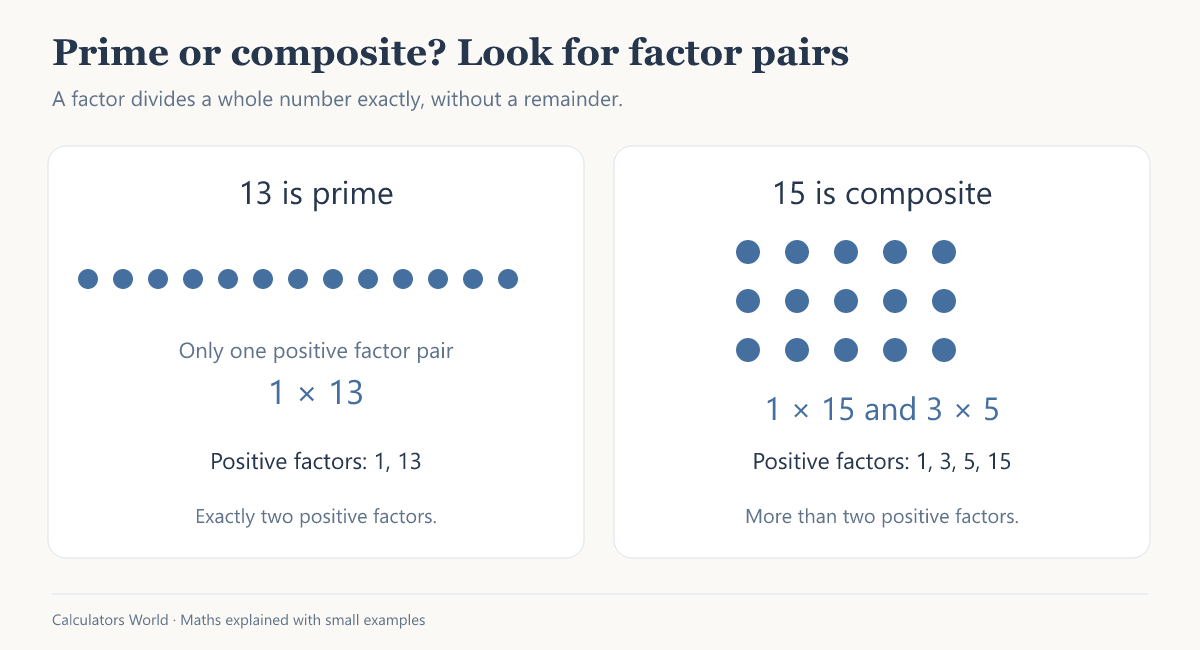
A prime is a whole number greater than 1 with exactly two positive factors: 1 and itself.
Take 13. You cannot divide it exactly by 2, 3, 4 or any other whole number between 1 and 13. Its only positive factors are 1 and 13, so it is prime.
Now take 15. Since 15 = 3 × 5, it has factors other than 1 and itself. It is composite. And 1 is neither prime nor composite: it has only one positive factor, not two.
Why write the record number as a power of 2?
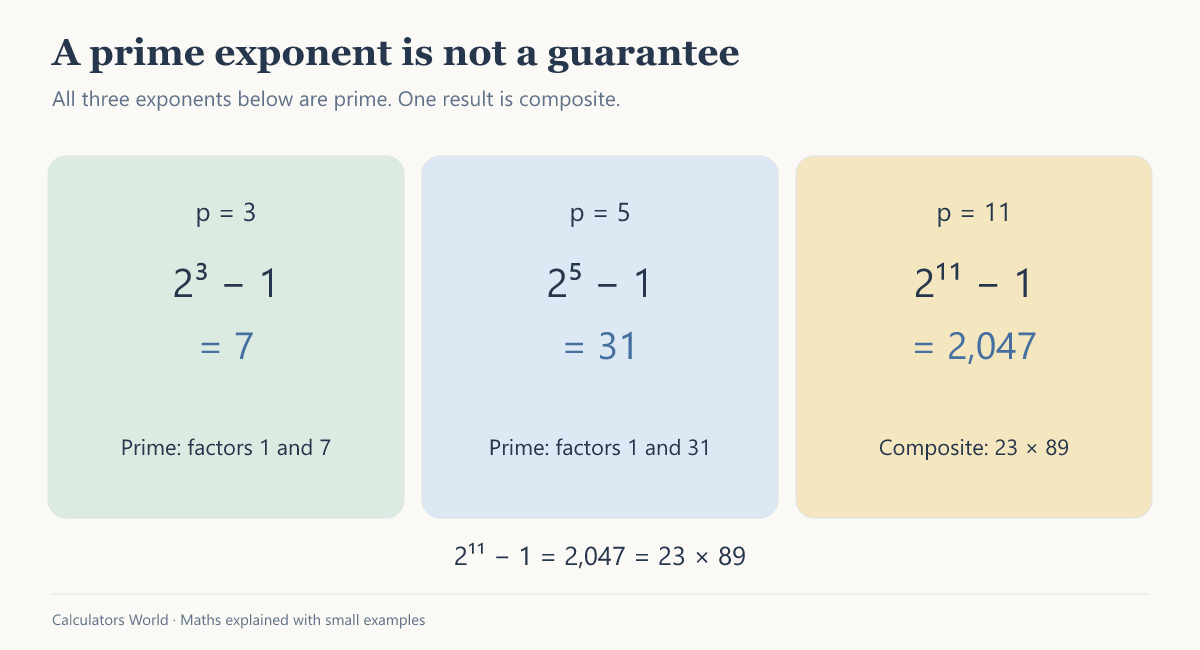
Numbers of the form 2p − 1 are called Mersenne numbers. Some are prime, but the formula does not guarantee it.
- 23 − 1 = 7, which is prime.
- 25 − 1 = 31, which is prime.
- 211 − 1 = 2,047, which is 23 × 89, so it is composite.
Notice that 11 is prime, yet 211 − 1 is not. Spotting a promising pattern gives you something to investigate; it does not settle the answer.
How would you check a smaller example?
Suppose you want to know whether 97 is prime. You do not need to try every whole number up to 96. If 97 were composite, at least one of its factors would be no greater than its square root. The square root of 97 is between 9 and 10.
Checking the primes 2, 3, 5 and 7 is enough. None divides 97 exactly, so 97 is prime. A composite divisor would itself have a prime factor, which is why you can concentrate on prime divisors.
You can check 97 and 2,047 with the factoring calculator. Use small examples there: the record number is far beyond the tool’s input limit.
Is this the last prime?
No. There are infinitely many primes, so there cannot be a largest prime of all. A record tells us how far the search has reached, not where the primes end.
Update checked 12 November 2026: this number still heads the GIMPS list of known Mersenne primes. The record is impressive, but the same basic question applies to it as to 13: does any positive whole number other than 1 and itself divide it exactly?
Written and sources checked on 12 November 2026. The story date above refers to the GIMPS announcement on 21 October 2024.